Tuesday, March 29, 2011

Paper Reading #17

Comments
Shena Hoffmann
Chris KAm
Reference Information
Title Why UI: Using Goal Networks to Improve User Interfaces
Author: Dustin A. Smith, Henry Lieberyman
IUI


Summary
     The motive behind this paper had to deal with improving user interfaces through user goals. If an application can go as far as understanding what the user wants to do, it can predict tasks for the user and reduce time. A map network of goals is laid out with details like time to get to them are laid out. Previous use of goal networks include: processing natural language, plan recognition, and recommendation systems. Also, the paper goes on to discuss a website that uses goals and plans to grab data for the goal library.


Discussion
   I really enjoyed reading this paper on goal modeling. I really like the idea of applications knowing the goals of users. This could cut down on time used by a dramatic marker. I would really like to use one of the systems to see how smooth it could be during real time use. It seems that this could be helpful for several systems.

Thursday, March 24, 2011

Microblogs for Obedience to Authority

Reference Information
Title - Obedience to Authority
Author - Stanley Milgram
Publisher - 1993 Harper Perennial

Chapter 1
    In this chapter, Milgram talks about the Nazi experiments. While discussing obedience he talks about how obedient a person is under bad circumstances. 


Chapter 2 
    In this chapter Milgram decides to talk about his study performances. Milgram talks about everything from, tasks involved, procedures, participants, locations, etc. 

Chapter 3
    Milgram, In chapter 3, goes on to discuss what college students, adults, and psychiatrists thought about the experiment. He talked about what they had predicted would happen. Most believe the subject wouldn't do what the leader would say. 

Chapter 4
      Here, Milgram goes on to talked about 4 different experiments, In the very 1st one, feedback was derived from a victim hitting a wall. The next one, the victim was yelling and screaming. The 3rd, this time the subject of the experiment was actually placed in the same room as the victim. Finally, the subject ordered the victim to put their hand on the plate, in order to get shocked. 

Chapter 5:
      In this chapter, Milgram decides to in depth with the many different subjects on the experiment. He discusses survey information and just basic knowledge about them.

Chapter 6
    In the 6th chapter, several variations were added to the original experiment to see if it would have the same results. Women were now brought into the experiment as well as moving the location somewhere else.

Chapter 7
     Milgram decides to talk more about subjects from a few different experiments, most of which were women. Thiis discussion talked about personal reactions and thoughts.

Chapter 8 
       This chapter talked about how changing various parts of the expermint eventually lead to different results. 

Summary
   It was interesting to look at all the different changes and modifications to the experiment by the author.We had read about this experiment in another book. I enjoyed reading about it previously so I thought it was really nice to get even more in depth information from this experiment.  


Paper Reading #16

Comments
 Chris KAm
Zachary Henkel

Reference Information
Title - Performance optimizations of virtual keyboards for stroke-based text entry on a touch-based table top
Author: Jochen Rick
USIT 2010


Summary
 This paper discusses a possible solution to tabletop text entry. User would stroke from one letter to the next without ever lifting their pen, or finger. The author goes on to discuss several different possibilites for keyboard setups as apposed to the basic QWERTY setup. The author conducts a user study on this scheme. This study found that changing the keyboard to optimize this text entry method would be very problematic. The keyboard has been the same for awhile and now so the author found people did not want to change it.
    
Discussion
   This paper was not my favorite by far. It seemed to have too much technological background. Most of it was filled with mathematical concepts and designs for the method. The concept is very cool though. I like the idea of simply dragging a pen across letters to change which words are entered. I do not, however, like concept of the author discussing possibly changing the QWERTY keyboard to optimize the solution. People are set with this keyboard and will be for years.

Tuesday, March 22, 2011

Full Blog Opening Skinner's Box

Reference Information
Title - Opening Skinner's Box
Author - Lauren Slater
Publisher - W.W. Norton & Company (2008)

Summary
For the most part, Lauren Slater does not have relation between chapters. They seem to be scattered discussions, mostly about psycological experiments. Chapter one talks about B.F. Sinner and reinformcement schedules. He talked about training dogs for hide-and-seek as well as reflexes of frogs. The idea was that there is no such thing as free will.

In the 2nd chapter, Milgram's experiments involving shock are discussed by Slater. The concept was to see how many people would hurt someone if an authority told them to. More than 60% of people would do so. The experiment was very controversial because of it being slightly after WWII.


Slater discusses David Rosenhan's psych hospital experiment in chapter 3. Several doctors said they were hearing "thud" noises in order to get admitted to the hospital. Once admitted, the doctors made no attempt to seem mentally challenged. They were still diagnosed with paranoid schizophrenia.


In the 4th chapter, the bystander effect was discussed. In the murder of Kitty Genovese, several people refused to help the girl who was being stabbed repeatedly on the street. 


The 5th chapter talked about cognitive dissonance, a lot of this chapter focussed around Linda Santo and her claim to be a saint sent from God.


Harry Harlow was discussed by Slater here in the 6th chapter. This experiment dealt with the attachment of young monkeys. The study concluded with the finding that monkeys became more attached to fake monkey rags than something that wasn't soft.


The 7th chapter talked about the rat park study by Bruce Alexander. The study found that rats placed in a very cramped cage tended to favor the morphine water far more than those places in a better, almost utopian setting. 


Chapter 8 discusses the study done by Elizabeth Loftus on false memory creation. The study found that false memories were able to be implanted into the mind of her subjects. This was very closely related to chapter 10 in which psychosugery was performed by Antonio Moniz


Chapter 9 talks about Kandel's research on memory. The study resulted in the finding of CREB which is an electrochemical signal reinforcement. This molecule produces proteins to help make memories. 

Discussion
Overall, this has been my favorite reading for the semester. I enjoyed reading all the psycological experiments done in this book. I have always been interested in psycology and the human brain so this is probably why I enjoyed this book so much. 

Paper Reading #15

Comments
Shena Hoffmann
Chris Kam

Reference Information
Title - Gesture Search: a tool for fast mobile data access

Author - Yang Li

UIST '10


Summary
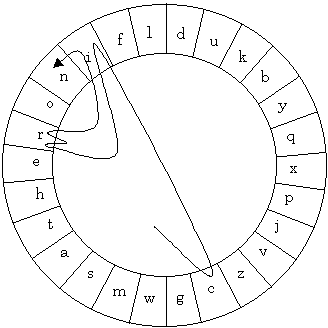
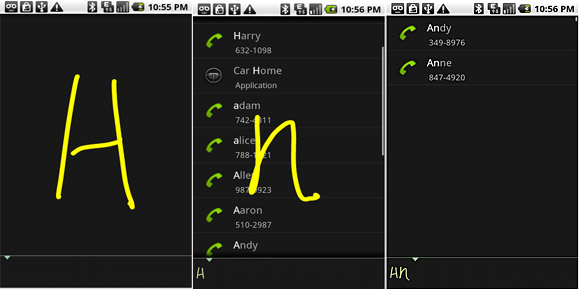
   The idea behind the Gesture Search tool is for a faster and more effecient method of searching on mobile devices. The tool allows for mobile devices to last longer Most devices today use a small area for input to search on the device. The Gesture Search tool allows for users to search the device using an input area that uses the entire screen. The search tool uses an input of character gestures by the user to search through data on the device. Eventually, the device learns the user's search history to improve the search.

Discussion
     This tool seems like it could be useful for people with poor vision or lack of good motor skills. Because older people have trouble touching a small space on the screen, it would be helpful for them to simply draw a gesture on the entire screen. This tool would also increase the speed at which the device can search, especially after learning the user's past search history. I also liked the fact that the study was not done in a lab, but rather by real time use.

Tuesday, March 8, 2011

Paper Reading #14

Comments

Reference Information
Title Eden: Support Home Network Management Through Interactive Visual Tools
Authors: Jeongwa Yang, Keith Edwards, David Haslem


Summary
   The main idea behid this paper was making network management easy for non-techical users. Eden's goal was to make it easier for user to manage networks by simplifying the process. The interface is actually modeled after a home. It seperates into different rooms with "walls" in between them. The interface also shows connections with physical wires in between connected computers. Also, it is very easy to manage these networks by simply dragging and dropping different features.

Discussion
    I really enjoyed this article about Eden. This could be extremely useful to people with little or no technical networking knowledge. This would be ideal for our parents/grandparents who didn't grow up with computers. I like the idea of the drag and drop feature to the system. This allows for extremely easy preference manipulation. Also, the physical splitting up of rooms is a good idea. This way users will not get confused with which computer is in which room at any time.

Thursday, March 3, 2011

Paper Reading #13

Comments
Shena Hoffmann
Chris Kam

Refrence Information
Title - TwinSpace: an infrastructure for cross-reality team spaces

Authors -Derek F. Reilly, Hadez Rouati, Andy Wu, Jee Yeon Hwang, Jeremy Brudvik, W. Keith Edwards
UIST 2010


Summary
   This paper discusses the idea of combining a virtual workspace with a physical one. The software is called TwinSpace. It supports physical mapping between the work spaces. This software uses an almost dual-reality within the virtual and physical spaces. Working in larger groups can become confusing at times because of this.  In this virtual workspace, people are represented that are present in the physical workspace as well. Event notification is also a very large aspect of TwinSpace. This allows for users to see what happened, and when. TwinSpace conducted a couple studies on the product. The first included a team brainstorming ideas in one room while one person held a presentation on the material in another .

Discussion
    I really like the concept of TwinSpace. It seem that business today is moving toward a multi-dimensional workspace. This allows for users all over the world to interact and discuss whatever is needed. I also like the event driven functionality. With so many users working together it is important that progress is tracked and viewable for late joiners to the meeting. Also, this allows for everybody to see how an idea was conceptualized.